


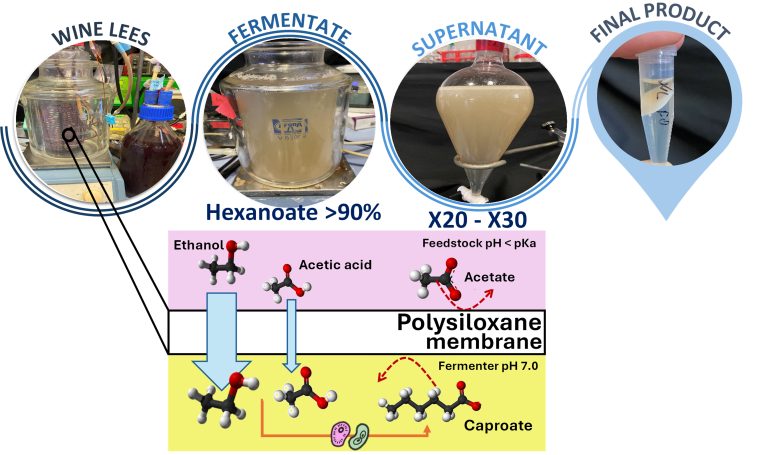
Technology description
Our silicone-membrane-based fermentation process converts ethanol-containing biowaste streams into high-purity valuable chemicals, such as hexanoate. The system allows to separate two differentiate liquid phases without cross-contamination. The membranes enable the selective transfer of compounds to enhance robust production.
Competitive benefits
- Reduction of the amount and environmental impacts of bio-waste
- Valorisation of ethanol-rich agri-food waste streams into a high-added value product like hexanoate
- Reduction of the use of fossil fuels and their environmental impacts
- Controlled substrate flux by simply tweaking operational parameters
- Stable operation with complex waste streams
- Creation of new business opportunities within the agri-food/biorefinery sectors
- Feedstock flexibility due to the compatibility with multiple streams and processes
- Lower downstream costs due to product selectivity and purity.
Research team and contact
The process has been developed by a multidisciplinary research team of the University of Girona with expertise in chemical engineering, microbiology and automatization. Contact: Dr Sebastià Puig (sebastia.puig@udg.edu).
Current status of technology development
The system has been successfully validated at laboratory scale (TRL4) and a patent has been filed (WO2024256436A1) to address IPR issues.
Desired cooperation
We seek to establish partnerships with technology developers, end-users and investors to optimize, upgrade, upscale and validate the system in industrial scenarios.