


Date: 13-03-2026
PhD dissertation "Towards the integrated operation of advanced technologies in the Figueres Drinking Water Treatment Plant", by Laura Ferràndez Galceran
Abstract
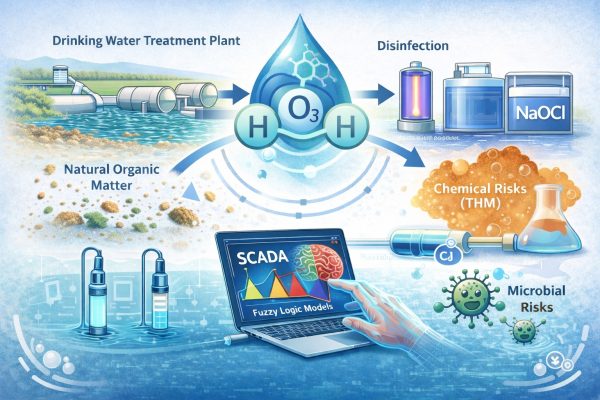
Drinking water treatment plants (DWTPs) are aimed at producing safe and high-quality drinking water under increasingly variable environmental and operational conditions. These facilities must continuously adapt their treatment strategies to ensure both chemical and microbiological safety, especially under the growing influence of anthropogenic pressures, climate variability, and more stringent regulations. Achieving this balance requires advanced monitoring and control strategies capable of integrating process knowledge, sensor data, and operational decision-making.
Within this context, Laura Ferràndez’s doctoral research proposes the development of control modules and a conceptual framework for an Environmental Decision Support System aimed at enhancing risk-based management and operational intelligence in DWTPs. The work has been conducted within the framework of an industrial doctorate in collaboration with water utility Figueres de Serveis S.A. (Catalonia, Spain), using the Figueres DWTP as case study. The research integrates experimental, modelling, and operational approaches to address the dual challenge of mitigating both chemical and microbiological risks in drinking water production.
The main outcome of this doctoral thesis is the design, implementation, and full-scale validation of a fuzzy inference system for dynamic ozone dose optimisation. By coupling 254 nm absorbance and temperature as real-time surrogates of natural organic matter reactivity, the model enables adaptive oxidation control under fluctuating raw-water conditions. The fuzzy-based controller demonstrated consistent predictive and adaptive behaviour, maintaining oxidation efficiency while minimising reagent consumption. This represents a robust proof of concept for the implementation of data-driven and knowledge-based control tools in DWTPs.
Beyond this validated module, two additional control modules have been conceptually developed. The first focuses on chemical risk assessment through predictive estimation of DBP formation potential, while the second targets microbiological risk evaluation based on organic carbon and bacterial regrowth indicators. Together, these modules constitute the foundation for a modular decision support framework proposed for future integration, enabling comprehensive, risk-informed operation across treatment processes.
In summary, this thesis contributes to bridging the gap between mechanistic understanding, experimental knowledge, and real-time operational control. The outcomes provide a methodological and conceptual basis for the gradual development of intelligent decision-support tools in drinking water treatment, moving towards predictive, adaptive, and resilient water management systems that ensure long-term safety, sustainability, and regulatory compliance.
The thesis has been directed by Dr Hèctor Monclús and Dr Alba Cabrera from LEQUIA research of the University of Girona (UdG), with a long-track record of research and technology transfer in drinking water systems. The PhD dissertation, which is open to the public, will be held on Friday 13th March at 10:00h at UdG Faculty of Sciences.