Date: 29-05-2026
PhD dissertation "Combining experimental and modelling approaches towards full-scale implementation for membrane bioreactor optimization", by Albert Galizia Amoraga
Dissertation: Friday 29th May, 10:00h, UdG Faculty of Sciences (Aula Magna)
Supervisors: Dr Hèctor Monclús, Dr Gaëtan Blandin and Dr Joaquim Comas
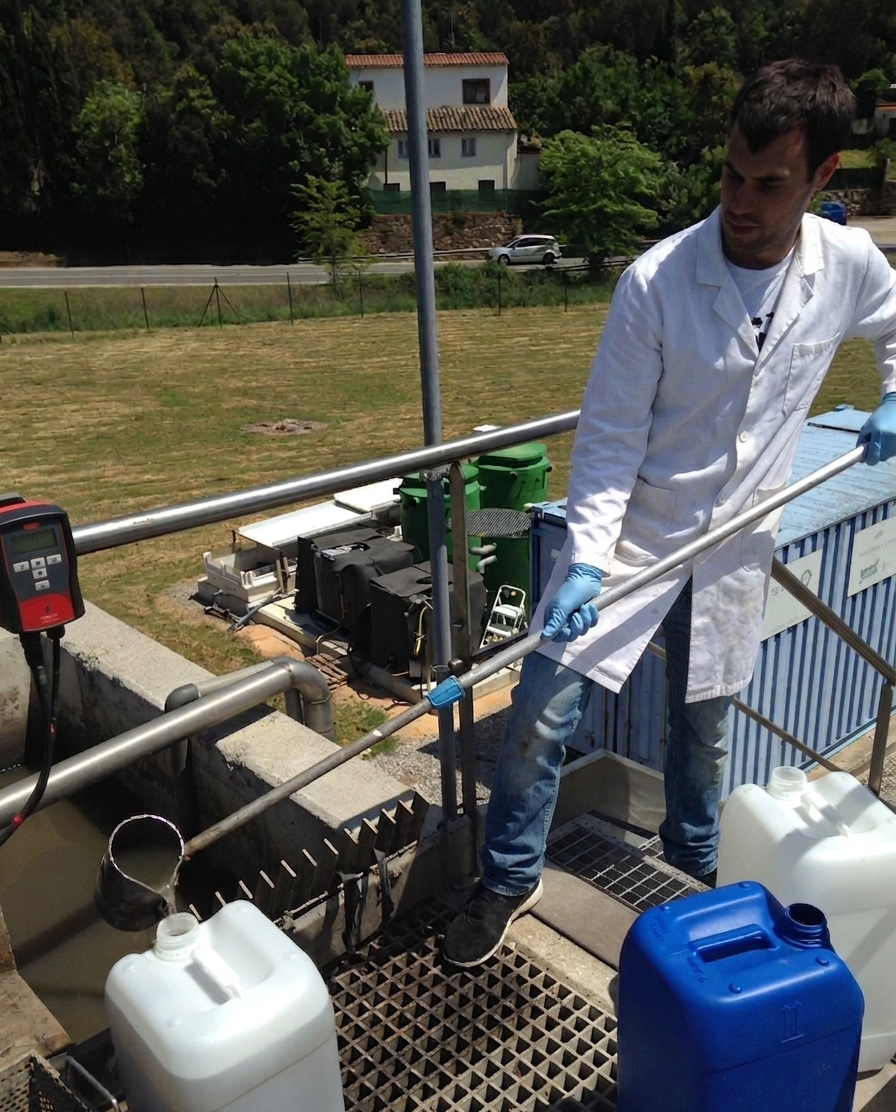
Photo: Albert Galizia working in one pilot plant of the thesis
Abstract: PhD-Albert Galizia_EN_CAT_ES
Main publications:
- Albert Galizia et al, Optimizing full-scale MBR performance: A dual-phase approach for real-time air-scouring and permeate flow modifications, Journal of Water Process Engineering, 66, 2024, 105992, https://doi.org/10.1016/j.jwpe.2024.105992.
- Albert Galizia et al, Integration of Specific Aeration Demand (SAD) into Flux-Step Test for Submerged Membrane Bioreactor. Membranes 2025, 15, 111. https://doi.org/10.3390/membranes15040111
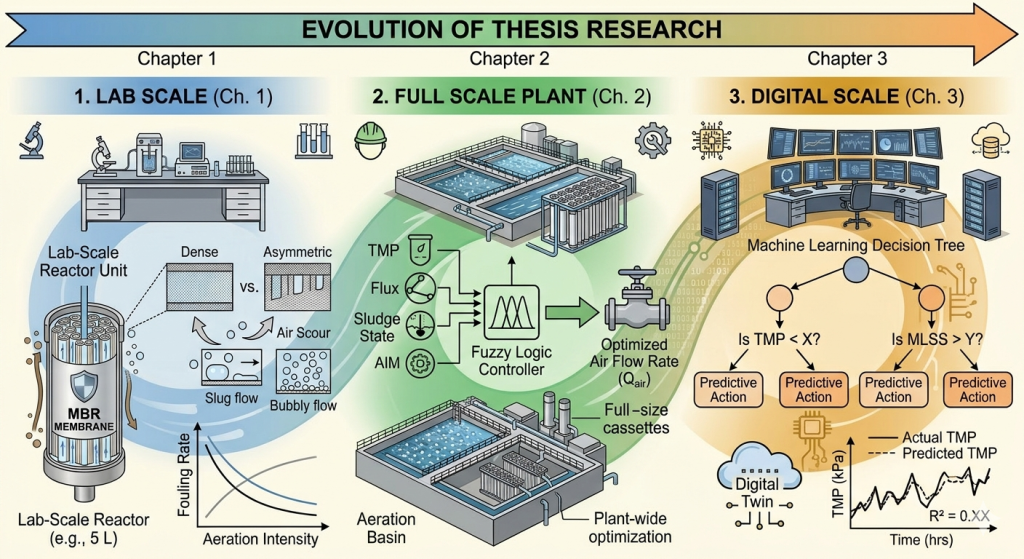
Membrane bioreactors (MBRs) are a cutting-edge technology for water treatment that offers excellent effluent quality in compact designs. However, their economic sustainability depends on overcoming two critical challenges: membrane fouling and the high energy consumption resulting from cleaning aeration. This thesis addresses these limitations through a holistic approach that integrates advanced experimental characterization, intelligent control, and predictive modeling.
Albert Galizia’s research starts redefining filtration evaluation by demonstrating that the critical flux test (Jc) is insufficient, as it ignores the interaction between membrane structure and aeration intensity. To address this, the researcher proposes the Aeration Step Test (AST), a new protocol that identifies specific aeration thresholds. This advancement allows for the replacement of generic strategies with optimized designs, demonstrating that membranes with similar critical flow rates can require radically different aeration intensities to maintain stability.
Making the leap from the laboratory to real-world operation, an automatic control system using fuzzy logic was developed and validated at the Sabadell “Riu Sec” plant (Catalonia, Spain) during eight months of continuous operation. Such controller operates in a dual and dynamic manner, regulating the cleaning air and monitoring permeate production in response to hydraulic stress events. The results are conclusive: the controlled line achieved a drastic reduction in the fouling rate (90% lower) and energy savings of 7% in the membrane air-blower compared to conventional operation. These findings confirm that integrating expert knowledge into intelligent algorithms enables much more autonomous and efficient operation.
Finally, the thesis completes this digital ecosystem by using machine learning to predict the evolution of transmembrane pressure (TMP). By incorporating uncertainty analysis into models like LightGBM, the tool not only anticipates fouling episodes, but it also provides reliable decision support for preventive maintenance planning, demonstrating that predictive accuracy depends more on data quality than on model complexity
Altogether, this research work demonstrates that the future of MBR systems is based on the convergence between experimental accuracy and digitalization, thereby transforming water treatment plants into intelligent, sustainable and resilient assets capable of adapting to water cycle’s challenges. The doctoral thesis has been directed by Dr. Hèctor Monclús, Dr. Gaëtan Blandin and Dr. Joaquim Comas, and is fully aligned with ongoing research on membrane technologies for water treatment currently developed at LEQUIA research group of the University of Girona, to which they belong.