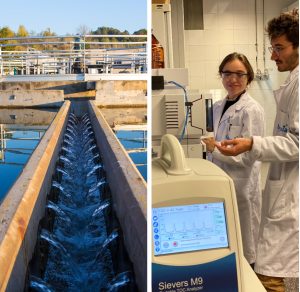
Universitat de Girona (UdG) is recruiting a researcher within the Horizon Europe Marie Sklodowska Curie doctoral network i3waterS – Intelligent, Innovative and Integrative Water Systems. The successful candidate will be enrolled in UdG PhD programme in Water Science and Technology.
Workplace: UdG Faculty of Sciences, Girona, Catalonia, Spain.
Main supervisor: Dr Hèctor Monclús, UdG (hector.monclus@udg.edu). Co-supervisor: Dr Alba Cabrera-Codony, UdG. Industrial supervisor: Dr Fernando Valero, ATL
Project duration: 3 years
Research objectives. The general objective is to develop artificial intelligence methodologies that integrate digital twins with advanced water quality and contaminants management modules to support resilient and sustainable operation of drinking water distribution systems. The recruited candidate will contribute to the general sub-objectives:
1) To generate a matrix of quality indicators for risk quantification and prediction by collecting data from multiple water sources, including desalination, surface water, reservoirs and groundwater.
2) To design and develop an SQI to quantify and evaluate risks, as well as to forecast potential risk scenarios in WDSs.
3) To implement and validate the SQI in real-world systems to improve the water supply management using multiple waters sources.
Expected Results: 1) A new tool for assessing risks in large water distribution systems that combine multiple water sources. 2) A scenario analysis tool to recommend the most effective management strategy for risk mitigation.
Benefits. Annual gross salary: 39.646€ (net salary + employee’s taxes and contributions). Permanent contract linked to i3WaterS project duration. Research and mobility costs: 40.000€
Foreseen secondments. Secondment 1: Three months at Universita degli Studi di Napoli Federico II (Italy), under the supervision of Dr Di Cristo. The doctoral candidate will receive specialised training in hydraulic systems management (contamination scenarios) and climate change related effects on water quality. Data collection will be conducted at GORI S.P.A. Secondment 2: Two months at VITENS NV (The Netherlands) for testing/validating the findings. Mentor: Dr Castro-Gama.
Requirements for candidates. Candidates must meet the following mandatory requirements:
1) Fulfill the requirements to access the doctorate at UdG in accordance with Spanish Royal Decree 576/2023, of 4th July, last amendment of Royal Decree 99/2011, of 28 January, regulating the official teaching of doctoral degrees (300 ECTS credits across university Bachelor and Master studies). Detailed information is provided on UdG Doctoral School website.
2) Have not resided or carried out their main activity (work, studies, etc.) in Spain for more than 12 months in the 36 months immediately before their recruitment date, and
3) Have fluency in English (C-1 level or upper)
The following technical competences and skills will be assessed: i) machine learning and data mining, ii) knowledge-based systems, iii) data-driven models, iv) explainable artificial intelligence, v) multi-agent systems, vi) decision support systems, vii) phython, R, Java or related programming languages, viii) data integration and interoperability, ix) documenting in Latex, and x) water science and technology. The following horizontal skills will be assessed: ability to work in teams, proactiveness and communication skills.
The hosting institution. The selected candidate will join the Laboratory of Chemical and Environmental Engineering (LEQUIA), a multidisciplinary research group of the University of Girona (Catalonia, Spain). Founded in 1993, LEQUIA is renowned for its work within the water sector. We have a multidisciplinary team of 40 people, including chemists, biologists, biotechnologists, environmentalists, engineers, computer scientists, and political scientists. Current research lines include: 1) Innovative processes of potabilization and (waste) water treatment; 2) Gas treatment and carbon dioxide bioconversion, and 3) Digitalisation and application of artificial intelligence to water cycle.
I3WaterS network. i3WaterS brings together leading universities, research centres, technology developers and water utilities across Europe. The project will train 15 Doctoral Candidates to develop innovative AI-driven solutions for intelligent, resilient and sustainable water systems, contributing to the digital transformation of one of the most critical infrastructures for society. i3WaterS training will uniquely integrate decades of knowledge, expertise & achievements in disciplines such as civil and computer engineering, hydroinformatics, geomechanics, applied mathematics, multi-objective optimization, high performance computing, big data, artificial intelligence, modelling, and data management, including soft skills facilitated by academic and non-academic partners.
| | List of candidates that have passed the first selection stage (7th October 2026) |
| | |
| 1 | Abushreitah, Alaa S.M. |
| 2 | Biagini, Elia |
| 3 | Boumessaoud, Romaissa |
| 4 | Delafargue, César |
| 5 | Djibril, Zarifou |
| 6 | Elhalil, Zeribar |
| 7 | Huzaifa Khan, Mohd |
| 8 | Kumar, Akash |
| 9 | Shabazi, Shhrok |