We are pleased to announce that the first article on the SPORE-MED project has been published in INDUSTRIAMBIENTE, magazine and portal for the environmental and energy sector, by our partner organisation GS INIMA.

Link

https://lequia-udg.com/spore-med.eu/wp-content/uploads/2025/02/SPORE_MED-INDUSTRIAMBIENTE24.pdf

We’re excited to announce a Special Session (Track 17) at the 7th Euro-Mediterranean Conference for Environmental
Integration (EMCEI-2025) focused on: Advancing Wastewater Treatment and Resource Recovery in the Mediterranean Region. The session will be sponsored by: SPORE-MED PRIMA Partnership

This session will highlight groundbreaking research and initiatives driving progress in wastewater treatment and sustainable resource recovery. It’s an incredible opportunity to connect with thought leaders, share your work, and collaborate on addressing critical challenges in the Mediterranean region.

📅 Submission Deadline: January 20, 2025 (to be extended)

More info at: https://lnkd.in/dUKmqM3d

Today, the SPORE-MED consortium met virtually for our 6-Month General Assembly. The meeting was an excellent opportunity to review our progress to date and strategise for the year ahead in 2025. Excitingly, we are on a great track to achieve our goals, thanks to the collaborative efforts of all partners involved!

We are thrilled to share the exciting progress being made on the SPORE-MED project as we work toward addressing water scarcity challenges in Morocco. This initiative is currently being implemented at the experimental farm at UM6P – University Mohammed VI Polytechnic. Our dedicated team (Redouane Choukrallah Amal AN-NORI Ngonidzashe Chirinda (Ph.D) Ibtissam Haouari Mohamed Louay Metougui and Bouchra Taouil, MBA Taouil is conducting comprehensive greenhouse trials to evaluate the effects of recycling treated wastewater and composted sewage sludge on the growth and productivity of two key crops: cowpea and sorghum.
These trials aim to provide valuable insights into how these secondary resources influence plant development, biomass yield, and overall soil health. By closely monitoring these parameters, we are generating essential data to support sustainable agricultural practices that can thrive in water-limited environments.
The results of this research will play a crucial role in shaping innovative strategies to enhance crop resilience, optimize resource use, and improve soil quality in regions facing significant water challenges. Stay tuned as we continue to share updates and findings from this groundbreaking project that holds great promise for sustainable agriculture in Morocco and beyond.

On December 2nd, our partner ADASA had the opportunity to present a part of the SPORE-MED project in the presentation of “Actividad Especial nº 6. Teledetección y Sensores” at the CONAMA 2024 Congress.

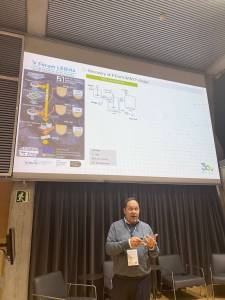
Our coordinator Jesus Colprim presented the SPORE-MED PRIMA Partnership project at the V Forum LEQUIA. He highlighted the development of leading edge technologies for sustainable treatment of contaminated waters including nutrient recovery, digitalization and social awareness.

The first Scientific Board meeting was held 3 months after the launch. Coordinators and work package leaders discussed the progress of each work package. The next Scientific Board meeting will be held in December.

From 23th to 24th July, the University of Sfax proudly organized UnivExpo at the International Fair of Sfax. On this occasion, the SPORE-MED project team had the privilege of being part of the University’s stand and sharing insights into this groundbreaking initiative.

On June 5th, the SPORE-MED partner organizations gathered at the Science and Technology Park of the University of Girona for the Kick-off Meeting. It was a great opportunity to meet with the project members to confirm the roles of each partner and to discuss the project objectives, timelines and expectations.

The innovative project deals with the upgrading of wastewater treatment plants for resource recovery, water reuse and health monitoring in the Mediterranean region.

We are looking forward to the start of a fruitful cooperation!

Today starts SPORE-MED project “SUSTAINABLE UPGRADED WASTEWATER TREATMENT PLANTS FOR RESOURCE RECOVERY, WATER REUSE AND HEALTH SURVEILLANCE IN THE MEDITERRANEAN REGION” led by LEQUIA research group from Universitat de Girona.

Coordinated by Jesus Colprim, SPORE-MED seeks to upgrade current urban wastewater treatment plants by making them more efficient and sustainable. The project, which will be executed for three years, has a consortium composed of seven universities and two large enterprises from Spain, Italy, Greece, Cyprus, Morocco, and Tunis: université de Sfax – University of Sfax (USS), Technical University of Crete, University of Cyprus, Università degli Studi di Salerno, Universitat Autònoma de Barcelona, UM6P – University Mohammed VI Polytechnic, GS Inima Environment, Adasa Sistemas and Universitat de Girona. Within Facultat_de_Ciències Universitat_de_Girona, SPORE-MED also involves researchers from UdG research group gEMM.

Urban wastewater treatment plants are key to returning the water used to the environment in the best conditions. Wastewater treatment plants are also a source of valuable resources – such as reclaimed water or nutrients – and a crucial element for wastewater-based surveillance. However, these facilities are still major energy consumers and are not capable of removing certain pollutants.

With a budget of 3,67M€, SPORE-MED has the goal of upgrading current wastewater treatment plants to respond to these and other challenges within the water-energy-food-health nexus in the Mediterranean region, more vulnerable to climate change and water scarcity than the world average. Innovative water treatment and resource recovery technologies, online monitoring tools, sustainable agro-practices for water and nutrient reuse, and several protocols and plans for wastewater surveillance and reuse will be developed and validated in four different demo sites in the participant countries.

SPORE-MED project is part of PRIMA Partnership supported by the European Union (GA: 2322).